Finding Kimchi: Designing a
Silent Game of Strategy and Suspense
Finding Kimchi: Designing a
Silent Game of Strategy and Suspense
I designed a silent card game inspired by the principles of game design and interaction design, where every sound could send a missing cat, Kimchi, further away.
Game Design
Product Design
Emergent & Social Gameplay Design
Product Design
At A Glance
At A Glance
User Insight & Discovery
User Insight & Discovery
Identified friction points around rule clarity, turn structure, and player motivation through user observation.
Identified friction points around rule clarity, turn structure, and player motivation through user observation.
Iteration & Testing
Iteration & Testing
Led two rounds of playtesting and used behavioral insights to redesign gameplay elements for better engagement and flow.
Led two rounds of playtesting and used behavioral insights to redesign gameplay elements for better engagement and flow.
System Design
System Design
Replaced shared metrics with individualized systems to increase player agency and introduce asymmetric risk.
Replaced shared metrics with individualized systems to increase player agency and introduce asymmetric risk.
UX Optimization
UX Optimization
Streamlined card UX by embedding rules into the design, improving task flow and reducing cognitive load during play.
Streamlined card UX by embedding rules into the design, improving task flow and reducing cognitive load during play.
After a long day out, you return home to find Kimchi, your skittish cat, missing.
In this silent card game, players race to collect clues, but every sound risks scaring Kimchi further. Silence isn’t just golden, it’s how you win.
Finding Kimchi blends tension, restraint, and playful deceit into a narrative-driven, sound-sensitive world where strategy meets self-control.
After a long day out, you and your friends return home to a surprising mystery, Kimchi, your skittish cat, has vanished. In this silent multiplayer card game, players race to gather clues to find him. But here’s the twist: every sound you make could scare Kimchi further away. Silence isn't just golden, it’s the only way to win.
"Finding Kimchi" is more than a game; it's a social experiment in tension, restraint, and playful deceit.
Designed with interaction principles in mind, the game invites players into a narrative-driven, sound-sensitive world where strategy must coexist with self-control.
After a long day out, you and your friends return home to a surprising mystery, Kimchi, your skittish cat, has vanished. In this silent multiplayer card game, players race to gather clues to find him. But here’s the twist: every sound you make could scare Kimchi further away. Silence isn't just golden, it’s the only way to win.
"Finding Kimchi" is more than a game; it's a social experiment in tension, restraint, and playful deceit.
Designed with interaction principles in mind, the game invites players into a narrative-driven, sound-sensitive world where strategy must coexist with self-control.
Design Challenge
Design Challenge
How might we design a non-verbal game that fosters tension, interaction, and humor, while maintaining strategic depth?
How might we design a non-verbal game that fosters tension, interaction, and humor, while maintaining strategic depth?
Design Principles
Constraint as Catalyst
Constraint as Catalyst
The silence rule shaped behavior and created emergent dynamics of anticipation and trust.
Cognitive Load Reduction
Cognitive Load Reduction
In-card instructions helped reduce rule referencing and improved immersion.
Player Agency
Player Agency
Power and utility cards balanced luck with strategic choice.
Game Feel & Pacing
Game Feel & Pacing
Tighter win/loss conditions and noise thresholds created a tense yet brisk experience.
Initial Game System
Initial Game System
Initial Game System
Silence as Gameplay
Players must remain silent. Any spoken word increases their shared noise meter.
Players must remain silent. Any spoken word increases their shared noise meter.
Win Condition
Be the first to gather the most Clue Points.
Shared Noise Meter must not exceed the limit (10 initially).
Be the first to gather the most Clue Points.
Shared Noise Meter must not exceed the limit (10 initially).
Losing Condition
The game ends if the shared Noise Meter exceeds the limit.
If you declare the highest sum of clue cards, but someone else has a higher sum, you lose.
The game ends if the shared Noise Meter exceeds the limit.
If you declare the highest sum of clue cards, but someone else has a higher sum, you lose.
Playtesting 1: Discoveries & Iterations
With fewer Noise Hazards in play, pacing slowed.
Iteration
Reduced Noise Meter cap from 10 to 5, then to 3, increasing urgency and risk.
Players avoided playing Noise Hazard cards to protect the shared Noise Meter.
Iteration
Introduced individual Noise Meters to shift accountability to each player and open up strategic manipulation.
Players hoarded Noise Hazard cards, stalling gameplay.
Iteration
Made Noise Hazards immediately resolvable upon drawing, preventing stockpiling.
With fewer Noise Hazards in play, pacing slowed.
Iteration
Reduced Noise Meter cap from 10 to 5, then to 3, increasing urgency and risk.
Players avoided playing Noise Hazard cards to protect the shared Noise Meter.
Iteration
Introduced individual Noise Meters to shift accountability to each player and open up strategic manipulation.
Players hoarded Noise Hazard cards, stalling gameplay.
Iteration
Made Noise Hazards immediately resolvable upon drawing, preventing stockpiling.
With fewer Noise Hazards in play, pacing slowed.
Iteration
Reduced Noise Meter cap from 10 to 5, then to 3, increasing urgency and risk.
Players avoided playing Noise Hazard cards to protect the shared Noise Meter.
Iteration
Introduced individual Noise Meters to shift accountability to each player and open up strategic manipulation.
Players hoarded Noise Hazard cards, stalling gameplay.
Iteration
Made Noise Hazards immediately resolvable upon drawing, preventing stockpiling.
With fewer Noise Hazards in play, pacing slowed.
Iteration
Reduced Noise Meter cap from 10 to 5, then to 3, increasing urgency and risk.
Players avoided playing Noise Hazard cards to protect the shared Noise Meter.
Iteration
Introduced individual Noise Meters to shift accountability to each player and open up strategic manipulation.
Players hoarded Noise Hazard cards, stalling gameplay.
Iteration
Made Noise Hazards immediately resolvable upon drawing, preventing stockpiling.
With fewer Noise Hazards in play, pacing slowed.
Iteration
Reduced Noise Meter cap from 10 to 5, then to 3, increasing urgency and risk.
Players avoided playing Noise Hazard cards to protect the shared Noise Meter.
Iteration
Introduced individual Noise Meters to shift accountability to each player and open up strategic manipulation.
Players hoarded Noise Hazard cards, stalling gameplay.
Iteration
Made Noise Hazards immediately resolvable upon drawing, preventing stockpiling.
With fewer Noise Hazards in play, pacing slowed.
Iteration
Reduced Noise Meter cap from 10 to 5, then to 3, increasing urgency and risk.
Players avoided playing Noise Hazard cards to protect the shared Noise Meter.
Iteration
Introduced individual Noise Meters to shift accountability to each player and open up strategic manipulation.
Players hoarded Noise Hazard cards, stalling gameplay.
Iteration
Made Noise Hazards immediately resolvable upon drawing, preventing stockpiling.
With fewer Noise Hazards in play, pacing slowed.
Iteration
Reduced Noise Meter cap from 10 to 5, then to 3, increasing urgency and risk.
Players avoided playing Noise Hazard cards to protect the shared Noise Meter.
Iteration
Introduced individual Noise Meters to shift accountability to each player and open up strategic manipulation.
Players hoarded Noise Hazard cards, stalling gameplay.
Iteration
Made Noise Hazards immediately resolvable upon drawing, preventing stockpiling.
With fewer Noise Hazards in play, pacing slowed.
Iteration
Reduced Noise Meter cap from 10 to 5, then to 3, increasing urgency and risk.
Players avoided playing Noise Hazard cards to protect the shared Noise Meter.
Iteration
Introduced individual Noise Meters to shift accountability to each player and open up strategic manipulation.
Players hoarded Noise Hazard cards, stalling gameplay.
Iteration
Made Noise Hazards immediately resolvable upon drawing, preventing stockpiling.
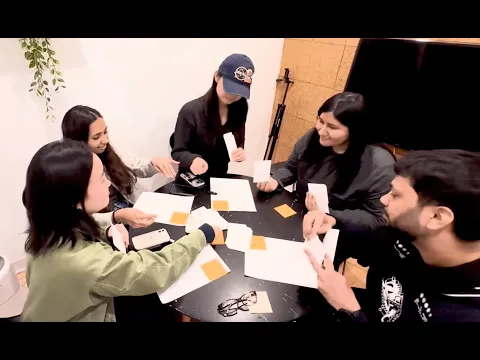
Playtesting Session
Playtesting 2: Refinement & Nuance
Playtesting 2: Refinement & Nuance
Players avoided using "Trade" Power Cards, as only valuable cards remained in hand.
Iteration
Revised mechanic, Trade Card player now forces a trade between two others, increasing uncertainty and strategic interference.
While silence was compelling, some found it too restrictive.
Iteration
Introduced "meowing", a playful alternative to speech that added humor and increased accidental noise events.
Players weren’t sure if resolving a Noise Hazard counted as a turn.
Iteration
Clarified: declaring a Noise Hazard counts as the player’s turn, reinforcing fairness and pacing.
Confusion about what happens to discarded Clue Cards.
Iteration
Clue Cards are reshuffled into the draw deck, ensuring ongoing access and reducing dead ends.
Players avoided using "Trade" Power Cards, as only valuable cards remained in hand.
Iteration
Revised mechanic, Trade Card player now forces a trade between two others, increasing uncertainty and strategic interference.
While silence was compelling, some found it too restrictive.
Iteration
Introduced "meowing", a playful alternative to speech that added humor and increased accidental noise events.
Players weren’t sure if resolving a Noise Hazard counted as a turn.
Iteration
Clarified: declaring a Noise Hazard counts as the player’s turn, reinforcing fairness and pacing.
Confusion about what happens to discarded Clue Cards.
Iteration
Clue Cards are reshuffled into the draw deck, ensuring ongoing access and reducing dead ends.
Players avoided using "Trade" Power Cards, as only valuable cards remained in hand.
Iteration
Revised mechanic, Trade Card player now forces a trade between two others, increasing uncertainty and strategic interference.
While silence was compelling, some found it too restrictive.
Iteration
Introduced "meowing", a playful alternative to speech that added humor and increased accidental noise events.
Players weren’t sure if resolving a Noise Hazard counted as a turn.
Iteration
Clarified: declaring a Noise Hazard counts as the player’s turn, reinforcing fairness and pacing.
Confusion about what happens to discarded Clue Cards.
Iteration
Clue Cards are reshuffled into the draw deck, ensuring ongoing access and reducing dead ends.
Players avoided using "Trade" Power Cards, as only valuable cards remained in hand.
Iteration
Revised mechanic, Trade Card player now forces a trade between two others, increasing uncertainty and strategic interference.
While silence was compelling, some found it too restrictive.
Iteration
Introduced "meowing", a playful alternative to speech that added humor and increased accidental noise events.
Players weren’t sure if resolving a Noise Hazard counted as a turn.
Iteration
Clarified: declaring a Noise Hazard counts as the player’s turn, reinforcing fairness and pacing.
Confusion about what happens to discarded Clue Cards.
Iteration
Clue Cards are reshuffled into the draw deck, ensuring ongoing access and reducing dead ends.
Players avoided using "Trade" Power Cards, as only valuable cards remained in hand.
Iteration
Revised mechanic, Trade Card player now forces a trade between two others, increasing uncertainty and strategic interference.
While silence was compelling, some found it too restrictive.
Iteration
Introduced "meowing", a playful alternative to speech that added humor and increased accidental noise events.
Players weren’t sure if resolving a Noise Hazard counted as a turn.
Iteration
Clarified: declaring a Noise Hazard counts as the player’s turn, reinforcing fairness and pacing.
Confusion about what happens to discarded Clue Cards.
Iteration
Clue Cards are reshuffled into the draw deck, ensuring ongoing access and reducing dead ends.
Players avoided using "Trade" Power Cards, as only valuable cards remained in hand.
Iteration
Revised mechanic, Trade Card player now forces a trade between two others, increasing uncertainty and strategic interference.
While silence was compelling, some found it too restrictive.
Iteration
Introduced "meowing", a playful alternative to speech that added humor and increased accidental noise events.
Players weren’t sure if resolving a Noise Hazard counted as a turn.
Iteration
Clarified: declaring a Noise Hazard counts as the player’s turn, reinforcing fairness and pacing.
Confusion about what happens to discarded Clue Cards.
Iteration
Clue Cards are reshuffled into the draw deck, ensuring ongoing access and reducing dead ends.
Players avoided using "Trade" Power Cards, as only valuable cards remained in hand.
Iteration
Revised mechanic, Trade Card player now forces a trade between two others, increasing uncertainty and strategic interference.
While silence was compelling, some found it too restrictive.
Iteration
Introduced "meowing", a playful alternative to speech that added humor and increased accidental noise events.
Players weren’t sure if resolving a Noise Hazard counted as a turn.
Iteration
Clarified: declaring a Noise Hazard counts as the player’s turn, reinforcing fairness and pacing.
Confusion about what happens to discarded Clue Cards.
Iteration
Clue Cards are reshuffled into the draw deck, ensuring ongoing access and reducing dead ends.
Players avoided using "Trade" Power Cards, as only valuable cards remained in hand.
Iteration
Revised mechanic, Trade Card player now forces a trade between two others, increasing uncertainty and strategic interference.
While silence was compelling, some found it too restrictive.
Iteration
Introduced "meowing", a playful alternative to speech that added humor and increased accidental noise events.
Players weren’t sure if resolving a Noise Hazard counted as a turn.
Iteration
Clarified: declaring a Noise Hazard counts as the player’s turn, reinforcing fairness and pacing.
Confusion about what happens to discarded Clue Cards.
Iteration
Clue Cards are reshuffled into the draw deck, ensuring ongoing access and reducing dead ends.
Final Game System
Final Game System
Final Game System
Silence as Gameplay
Players must remain silent. Any spoken word increases their individual noise meter.
Players can now “meow.”
Players must remain silent. Any spoken word increases their individual noise meter.
Players can now “meow.”
Noise Meter
A core mechanic that tracks how much noise a player makes. It represents how close you are to scaring Kimchi away.
Was shared (threshold 10) → now individual (threshold 3).
A core mechanic that tracks how much noise a player makes. It represents how close you are to scaring Kimchi away.
Was shared (threshold 10) → now individual (threshold 3).
Card Types
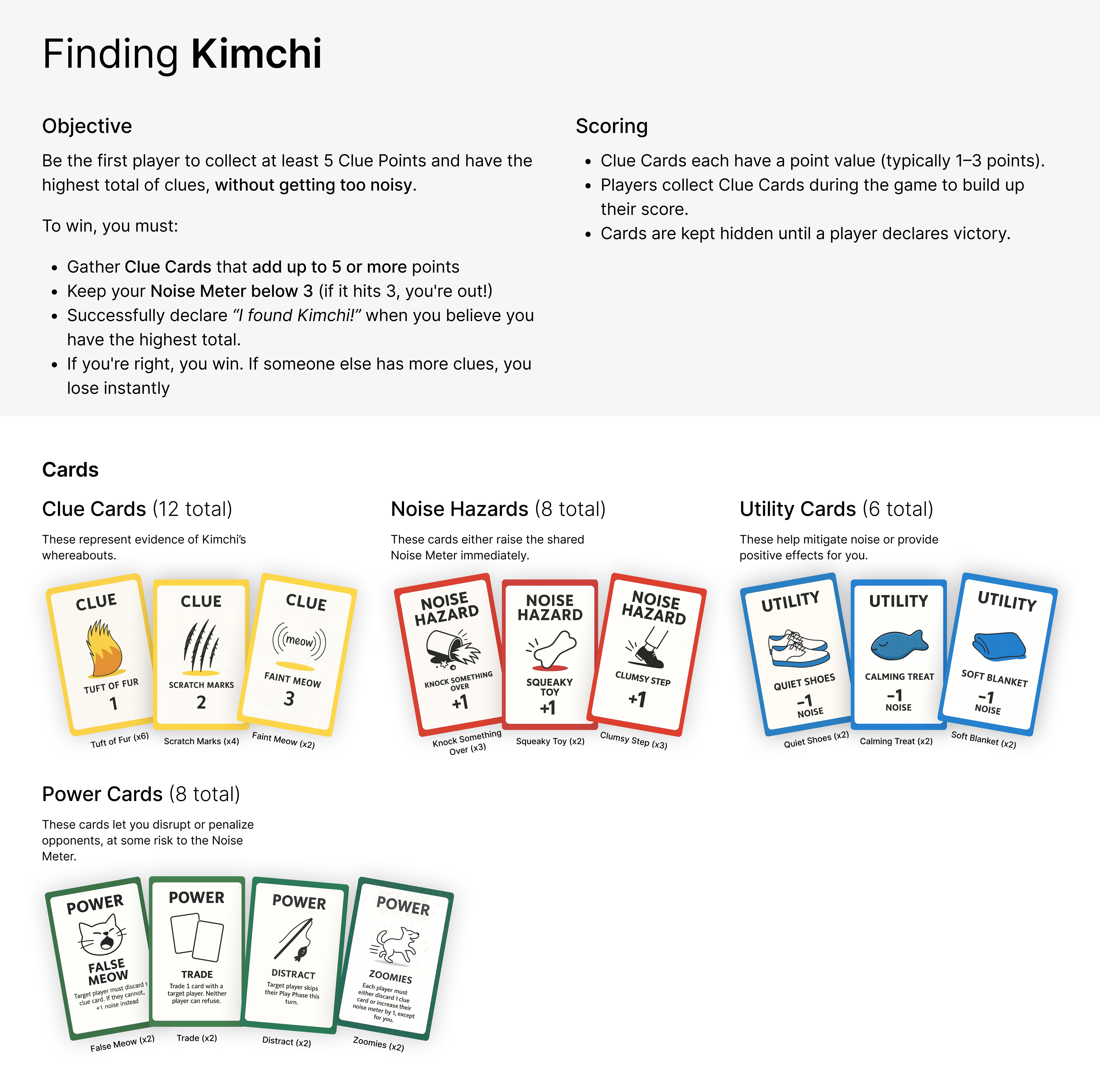
Clue Cards
These represent evidence of Kimchi’s whereabouts. Each card also has a point value.
Noise Hazards
These cards either raise the shared Noise Meter immediately.
Utility Cards
These help mitigate noise or provide positive effects for you.
Power Cards
These cards let you disrupt or penalize opponents, at some risk to the Noise Meter.
Clue Cards
These represent evidence of Kimchi’s whereabouts. Each card also has a point value.
Noise Hazards
These cards either raise the shared Noise Meter immediately.
Utility Cards
These help mitigate noise or provide positive effects for you.
Power Cards
These cards let you disrupt or penalize opponents, at some risk to the Noise Meter.
Win Condition
Be the first to gather the most Clue Points and have the highest clue total.
Shared Noise Meter must not exceed the limit (from 10 to 3)
Be the first to gather the most Clue Points and have the highest clue total.
Shared Noise Meter must not exceed the limit (from 10 to 3)
Be the first to gather the most Clue Points and have the highest clue total.
Shared Noise Meter must not exceed the limit (from 10 to 3)
Losing Condition
If your Noise Meter reaches 3.
If you declare the highest sum of clue cards, but someone else has a higher sum, you lose.
Be the first to reach ≥3 Clue Points and have the highest total without hitting the noise limit.
Game Design Concepts in Play
Emergent Gameplay: Simple rules give rise to rich interactions, players invent silent tactics like gestures and meows, making each round feel fresh and social.
Risk vs. Reward: Every action carries weight: draw a card and risk a Noise Hazard, or play it safe and fall behind. Strategy hinges on calculated risk.
Constraint as Design: Silence isn’t just a rule, it’s a narrative and design constraint that deepens immersion and play tension.
Pacing & Flow: Lowering the Noise Meter cap sharpened the game’s tempo, creating urgency without dragging out rounds.
Player Agency & Chaos: Strategic tools like Utility and Power Cards give players control, while unpredictable hazards keep them adapting in real time.
Asymmetric Risk: Personal Noise Meters shift the stakes, each player must manage their own tension, making sabotage and bluffing viable.
Theme-Mechanic Harmony: Every detail, from silence to card types, serves the story of finding a lost, skittish cat. Thematic and mechanic choices are deeply intertwined.
Game Design Concepts in Play
Emergent Gameplay: Simple rules give rise to rich interactions, players invent silent tactics like gestures and meows, making each round feel fresh and social.
Risk vs. Reward: Every action carries weight: draw a card and risk a Noise Hazard, or play it safe and fall behind. Strategy hinges on calculated risk.
Constraint as Design: Silence isn’t just a rule, it’s a narrative and design constraint that deepens immersion and play tension.
Pacing & Flow: Lowering the Noise Meter cap sharpened the game’s tempo, creating urgency without dragging out rounds.
Player Agency & Chaos: Strategic tools like Utility and Power Cards give players control, while unpredictable hazards keep them adapting in real time.
Asymmetric Risk: Personal Noise Meters shift the stakes, each player must manage their own tension, making sabotage and bluffing viable.
Theme-Mechanic Harmony: Every detail, from silence to card types, serves the story of finding a lost, skittish cat. Thematic and mechanic choices are deeply intertwined.